
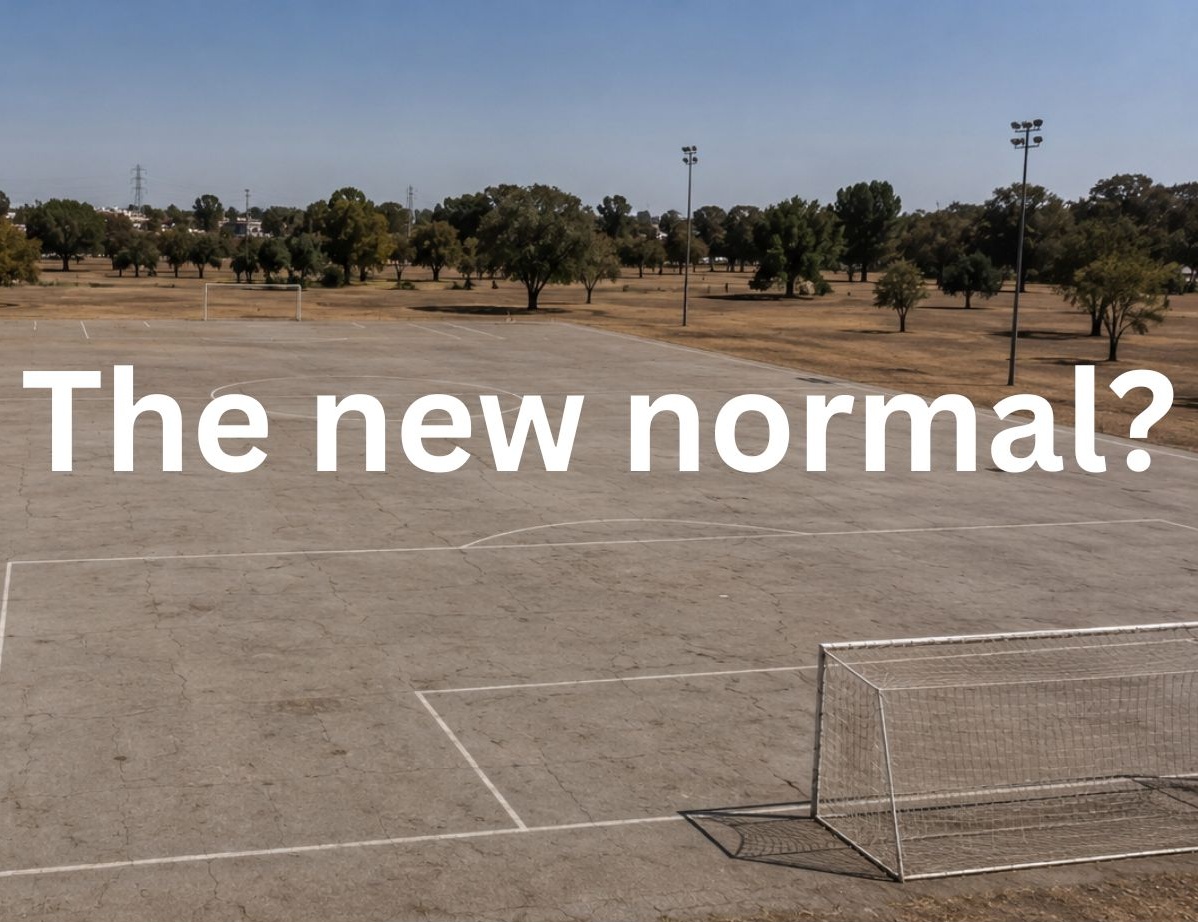
The summer of 2026 has been exceptionally hot and dry. At the time of writing (mid-August 2026), 71.3% of England and the whole of Wales are designated as drought areas.
An article published by the Guardian on 26 July 2026 reported scientific analysis which suggests that ‘extreme heat supercharged by the climate crisis is sucking Europe dry in summer and intensifying the drought hitting the continent’. As this article goes on to report, ‘droughts have usually been linked to low rainfall, but western Europe’s most recent winter was a wet one’.
Drought has unexpectedly become a playing pitch problem, but excessive water is also bound to return. We now have two extremes to deal with instead of one.
Schedule disruption
This summer’s record drought has brought disruption to rugby and football schedules before they’ve even begun. The Anglian Combination League – consisting of 85 amateur football teams in Norfolk and Suffolk – has postponed the start of its 2026/27 season because most pitches are dried ‘rock hard’ and ‘too dangerous to play on’. The RFU has also deferred the start of the competitive season for the majority of teams.
Meanwhile, at the big-money end of things in the Premier League and other pitch sports competitions, everything’s kicking off on schedule with all the usual fanfare. A dramatic contrast to the situation in community-level grass pitch sports.
Winter pitch sports schedules are more used to disruption from waterlogged playing surfaces. But now the opposite is true. With playing on grass akin to playing on concrete, it’s not realistic for seasons to get underway when they were supposed to. Who’d want to be a goalkeeper or be making numerous rugby tackles on surfaces this unforgiving?
Too dry and too wet. Investment in maintenance is crucial
Back in 2023, the Game Changer II report published by the British Association for Sustainable Sport assessed the national impact of climate change on sport in the UK. It noted that 60% of cricket players/spectators had experienced disruption (such as rescheduling, reduction in match duration) in the year from October 2022-October 2023 due to weather extremes associated with climate change. The figure for football was 40%.
A linked evaluation of pitch quality issues in London, based on a sample of recently delivered playing pitch strategies, indicated a substantial proportion of ‘poor’ quality provision (i.e., pitches which can only cater for one adult match per week). For example, 24% of pitches in Richmond-on-Thames were poor quality as opposed to 13% which were rated good. The ratio in Sutton was 35% poor, 33% good. In Newham, 36% were rated poor and only 13% good.
More recently, KKP’s 2026 report for Sport England and London Sport noted almost universal confirmation that the quality of public sector owned/managed grass pitch stock in the capital is declining due to limited or no investment in maintenance, repair and renewal.
Meanwhile, the joint FA, ECB, Institute of Groundsmanship (IOG) and Sport England report ‘Successful Management of Dual Use Cricket and Football Sites’ notes the impact that climate change is having and the increased periods of more extreme weather – both high rainfall and drought. It references the challenges this adds to pitch preparation and the requirement for more careful planning and management of resources.
Extended dry spells disrupt the delicate balance of soil and turf health. Without sufficient moisture, grass growth slows dramatically, leaving surfaces brittle, discoloured and vulnerable to wear. Soil compaction increases, reducing aeration and nutrient uptake. In some areas, depending on soil types and depth, the ground cracks, posing serious safety risks and complicating renovation efforts.
When rain finally returns, the problems often worsen. Hardened soil repels water, causing it to run off rather than soak in. This runoff can accumulate in low-lying areas, leading to pooling or flooding.
Worse still, when water mixes with dead, dried-out grass, it creates a sludge-like layer that suffocates new growth and delays recovery. These conditions can render pitches unplayable for extended periods unless addressed swiftly and strategically.
(Source: AA Sherriff & Son).
Water management is a key consideration in both periods of high and low rainfall.
Water management is therefore a key consideration in periods of both high and low rainfall.
So, where financial investment is high, business carries on as usual. But for everyday playing fields, which often receive only limited maintenance, drought and flooding extremes are causing problems to spiral out of control.
Protecting community participation in sport
There has been much trumpeting of the rising number of young people playing football, and the increased profile of the women’s and girls’ game. Conversely, men’s community and amateur 11-a-side football has faced a notable structural (and numeric) decline over recent decades. The same is true of rugby union, where many clubs which used to field four, five or even six men’s teams on a Saturday are now down to a couple.
A range of reasons, including cost and changing lifestyle expectations for this have been cited. But, as Covid illustrated, simply not having the opportunity to play can be a major factor.
There is a proposed government investment of £400 million on the table for community sports facilities, which could be hugely significant for protecting playing fields and keeping them usable.
Given the ongoing weather situation, we are wondering when it will be possible to realistically assess the condition of the existing stock, and to what degree the long-term damage caused by this year’s drought can be evaluated.
And let’s not forget, grass pitches and related space play an important role mitigating the ‘urban heat island effect’. The loss of pitches and natural green surfaces – which retain and reflect less heat than roads and buildings – has the effect of notably raising urban temperatures.
Where do we go from here?
The 2026 summer period pitch recovery has already been impeded. Grounds are too hard to play on and, when it does rain, the soil will take longer to soften.
Delays to season commencements, plus the likelihood of further match cancellations when rain returns, will lead to extreme match congestion later (or potential season extension). This is on the presumption that pitches will make some degree of recovery.
So, what should we be doing about it now?
Mass football relocation to 3G is unlikely to be feasible.
Are we looking at
• reduced league schedules (essentially fewer matches)?
• shortening matches to enable more to be played on useable pitches?
• leagues being more flexible about kick-off times, so local authorities and other pitch providers can deliver more opportunity on days when pitches are playable?
• …or what?
There are, of course, no easy answers. But should we not, as a united sector, be asking the questions, challenging some of the established orthodoxy and planning for what, climatically, would appear likely to be ‘the new normal’?
Want to comment on this article and join the conversation? Head over to our LinkedIn post